Richard Peery and Akio Toyoda built remarkable careers in two very different industries. Peery found opportunity in the land beneath Silicon Valley. Toyoda rose through one of the world’s largest automobile companies. Their stories do not involve a known partnership, yet they offer a valuable comparison of wealth creation, leadership, patience, and long-term vision.
Peery became a major figure in American commercial real estate. His investments helped provide office space for Silicon Valley’s growing technology sector. Toyoda, meanwhile, guided Toyota through economic pressure, safety concerns, technological change, and a worldwide shift toward cleaner transportation.
Their backgrounds and responsibilities differ greatly. However, both men understood that lasting success rarely happens overnight. Each built influence through decades of careful decisions.
Who Is Richard Peery?
Richard “Dick” Peery is an American real estate investor and developer. He is best known for his role in the commercial growth of Silicon Valley.
Peery grew up around property and finance. His father, H. Taylor Peery, had already established a family real estate business. This environment gave Richard early exposure to land, investment, and property management.
He attended Brigham Young University and later studied at Stanford. However, his most important education came from practical experience. He learned how location, timing, financing, and economic growth could affect the value of commercial property.
Unlike a technology founder, Peery did not create software or electronic products. Instead, he developed the physical spaces that expanding companies needed. That decision placed him in a powerful position as Silicon Valley grew into a global technology centre.
Partnership With John Arrillaga
A defining moment in Peery’s career came through his partnership with fellow real estate developer John Arrillaga.
Beginning in the 1960s, the pair acquired agricultural land in areas that later became central parts of Silicon Valley. At the time, the region looked very different. Orchards and open spaces occupied land that would eventually host offices, research centres, and technology campuses.
Peery and Arrillaga recognised the area’s potential early. They bought land, developed business properties, and attracted corporate tenants. Their portfolio grew alongside the technology industry.
Major companies needed well-located offices as they expanded. Peery and Arrillaga helped meet that demand. Their buildings became part of the infrastructure supporting one of the most valuable business regions in the world.
In 2006, the partners reportedly sold a large group of properties for approximately $1.1 billion. The transaction showed the scale of the portfolio they had created over several decades.
How Richard Peery Built His Real Estate Fortune
Peery’s success came from patience rather than rapid speculation. Commercial property development often requires years of planning. Investors must evaluate land prices, construction expenses, potential tenants, local development, and future demand.
Peery concentrated on a region with exceptional growth potential. Instead of shifting frequently between unrelated markets, he developed detailed knowledge of Silicon Valley. That focus helped him understand where companies might expand and what types of buildings they would require.
His career also demonstrates the importance of supporting industries. Technology founders received much of the public attention during Silicon Valley’s rise. However, those businesses still needed offices, warehouses, research facilities, roads, and services.
Peery earned wealth by serving that underlying demand. His success reminds entrepreneurs that profitable opportunities often exist around a growing industry, not only within it.
Forbes has listed him among the world’s billionaires. Any net-worth figure attached to him remains an estimate because private property values, debts, sales, and investments can change. Still, his fortune reflects the enormous commercial value created through his real estate activities.
Peery’s Philanthropic Work
Richard Peery has also been linked with charitable and educational projects. The Peery Foundation supports organisations addressing poverty and other social challenges. His family has played an active role in directing this work.
The family has also supported Brigham Young University. Their contributions helped establish an institute honouring H. Taylor Peery. Its work supports financial education, student development, and professional opportunities.
This part of Peery’s life receives less attention than his property portfolio. Nevertheless, it shows how his family has used part of its business success to support education and community programmes.
Who Is Akio Toyoda?
Akio Toyoda is a Japanese business leader and a member of Toyota’s founding family. He was born on May 3, 1956, and is the grandson of Toyota Motor Corporation founder Kiichiro Toyoda.
His family name gave him a connection to the company, but it did not allow him to avoid the normal demands of corporate leadership. He spent decades working through different departments and international assignments before becoming Toyota’s top executive.
Toyoda studied law at Keio University in Japan. He later completed an MBA at Babson College in the United States. This combination of Japanese and American education helped prepare him for work in a global organisation.
He joined Toyota in 1984. During his early and middle career, he gained experience in sales, marketing, production, product development, information technology, purchasing, and overseas operations.
That broad exposure proved valuable. A global automobile company involves far more than designing cars. It must manage complex factories, suppliers, dealerships, regulations, customer expectations, and safety standards across many countries.
His Rise Through Toyota
Toyoda joined Toyota’s board in 2000 and later accepted increasingly senior positions. His experience included responsibility for operations in Japan, Asia, Europe, and North America.
He also worked with New United Motor Manufacturing, Inc., commonly known as NUMMI. Toyota operated this California manufacturing venture with General Motors. His role there gave him direct insight into American manufacturing and workplace culture.
In June 2009, Toyoda became president of Toyota Motor Corporation. He took control during a difficult period. The global financial crisis had damaged vehicle demand, while the automobile industry faced growing environmental and technological pressure.
Toyota later encountered a major recall crisis involving concerns about unintended acceleration. Toyoda appeared before the United States Congress in 2010 and apologised to customers. The experience tested his leadership and placed the company’s quality systems under intense public scrutiny.
He remained Toyota’s president until 2023. He then became chairman, allowing a new generation of executives to manage more of the company’s daily operations while he continued to influence its broader direction.
Akio Toyoda’s Leadership Philosophy
Toyoda frequently focused on making “ever-better cars.” That idea connected corporate decision-making with the experience of customers and drivers.
He also encouraged Toyota to see itself as a mobility company rather than only an automobile manufacturer. This broader vision included connected services, new transportation systems, automated technology, and alternative power sources.
Toyoda’s leadership became especially notable during the debate over electric vehicles. Several manufacturers announced aggressive plans to replace petrol-powered cars with battery-electric models. Toyota followed a more diverse strategy.
The company continued to invest in conventional hybrids, plug-in hybrids, battery-electric cars, hydrogen fuel-cell vehicles, and other technologies. Toyoda argued that customer needs and energy systems vary between countries. Therefore, one solution may not serve every market at the same speed.
Critics believed Toyota moved too cautiously on fully electric vehicles. Supporters viewed the approach as practical and flexible. Regardless of the debate, it reflected Toyoda’s preference for managing risk across several technological options.
Motorsport and the Morizo Identity
Toyoda’s passion for cars extends beyond the boardroom. He has competed in motorsport under the name “Morizo.”
His racing activities strengthened his public image as an executive who genuinely enjoys driving. They also supported Toyota Gazoo Racing, the company’s performance and motorsport division.
Toyoda sees racing as a demanding testing environment. Engineers can learn how vehicles respond to heat, speed, pressure, and difficult road conditions. Those lessons may later improve production cars.
This personal involvement separates him from executives who treat vehicles only as commercial products. For Toyoda, cars carry emotional and cultural value in addition to their practical purpose.
Are Richard Peery and Akio Toyoda Connected?
There is no reliable public evidence that Richard Peery and Akio Toyoda are relatives, business partners, or close personal associates. Their documented careers developed separately.
Peery operated mainly in American commercial real estate. Toyoda built his career within a Japanese automobile manufacturer. Neither man appears as an important figure in the other’s recognised professional history.
The two names make sense together as a business comparison. Both inherited a connection to an established family enterprise, but each still had to develop his own professional identity. Both also benefited from recognising changes that could reshape an industry over many years.
Readers should therefore avoid interpreting the combined search phrase as evidence of a hidden relationship. The meaningful connection lies in the lessons their careers provide.
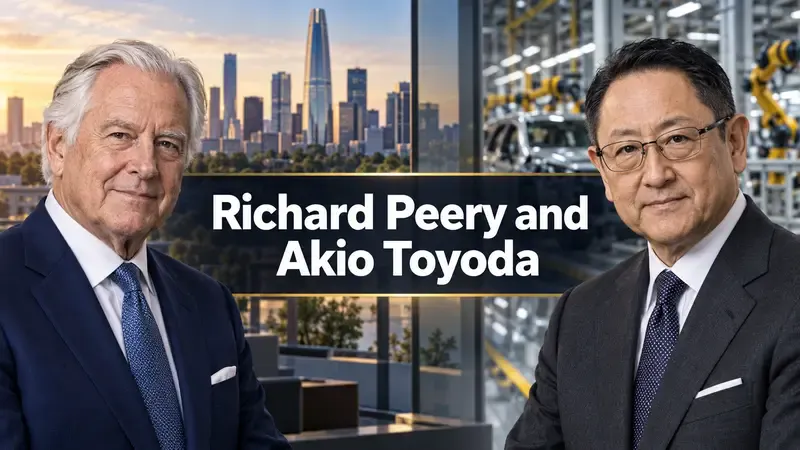
Richard Peery and Akio Toyoda Compared
| Category | Richard Peery | Akio Toyoda |
|---|---|---|
| Nationality | American | Japanese |
| Primary industry | Commercial real estate | Automotive manufacturing |
| Best known for | Silicon Valley property development | Leadership of Toyota |
| Major association | John Arrillaga | Toyota Motor Corporation |
| Education | Brigham Young University and Stanford studies | Keio University and Babson College |
| Leadership style | Private, patient, investment-focused | Public, operational, product-focused |
| Source of influence | Land and commercial buildings | Corporate leadership and mobility strategy |
| Additional interests | Philanthropy and education | Motorsport and vehicle development |
| Known direct relationship | None publicly established | None publicly established |
Important Similarities Between Their Careers
At first, these men appear to have little in common. One worked with buildings, while the other worked with vehicles. A closer look, however, reveals several useful similarities.
Strong Family Foundations
Both men entered fields in which their families already had experience.
Peery followed a path shaped by his father’s property business. Toyoda joined the company established by his grandfather. These foundations gave them access to knowledge and opportunity, but neither career depended on a family name alone.
Peery expanded a relatively modest property operation into a major commercial portfolio. Toyoda worked for about 25 years before becoming Toyota’s president. Each had to demonstrate judgment, persistence, and leadership.
Long-Term Decision-Making
Real estate development requires patience. A piece of land may take years to reach its full commercial value. Likewise, automobile development involves long product cycles, costly factories, extensive testing, and complex supply networks.
Both men operated in industries where poor long-term decisions can create serious losses. Their success depended on looking beyond immediate results.
Peery anticipated the demand that Silicon Valley’s expansion would create. Toyoda prepared Toyota for a future involving several forms of lower-emission transportation.
Adaptation to Economic Change
Peery’s business grew as agricultural communities transformed into technology centres. He responded to changing land use and corporate demand.
Toyoda led Toyota during recessions, natural disasters, recalls, supply-chain interruptions, and rapid technological change. He had to protect the company’s strengths while preparing it for an uncertain future.
Both careers show that leaders cannot control economic change. They can only observe it carefully and decide how to respond.
The Biggest Differences Between Them
The clearest difference lies in the nature of their responsibilities.
Peery acted primarily as an investor and developer. He evaluated properties, financed projects, managed tenants, and benefited from rising commercial demand. Much of his success occurred away from the public eye.
Toyoda led a highly visible multinational corporation. His decisions affected employees, suppliers, dealers, investors, governments, and millions of customers. Product safety issues or strategic mistakes could quickly become international news.
Their public personalities also differ. Peery maintains a relatively private profile and rarely appears in mainstream coverage. Toyoda frequently speaks at corporate events, meets the media, participates in racing, and represents Toyota around the world.
Finally, their main assets are different. Peery created value through fixed physical property. Toyoda managed a company built around manufacturing expertise, technology, people, brands, and worldwide distribution.
Business Lessons From Richard Peery and Akio Toyoda
Their experiences offer practical lessons for investors, managers, and entrepreneurs.
Look Beyond the Most Visible Opportunity
During Silicon Valley’s expansion, technology companies attracted most of the attention. Peery recognised that those companies needed property. He found opportunity in the infrastructure surrounding the celebrated industry.
Entrepreneurs can apply the same idea today. A growing sector creates demand for suppliers, training, logistics, security, maintenance, property, and professional services.
Learn the Entire Organisation
Toyoda worked across different areas of Toyota before taking its highest position. That experience helped him understand how decisions in one department could affect the rest of the company.
Future leaders should avoid learning only one narrow function. Knowledge of customers, operations, finance, employees, and products produces stronger decisions.
Protect Trust During Difficult Times
Toyoda’s response to Toyota’s recall crisis demonstrated the importance of accountability. A leader cannot always prevent a crisis, but that leader can take responsibility and improve the organisation’s response.
Peery’s long relationships with partners and tenants also suggest the value of credibility. In property and manufacturing, trust supports lasting business relationships.
Avoid Depending on One Future
Toyoda’s multi-technology strategy reflects a broader risk-management principle. When the future remains uncertain, maintaining several workable options can protect an organisation.
Peery used a different form of focus. He concentrated on commercial real estate but built across an expanding regional market. Both approaches balanced commitment with awareness of changing conditions.
Frequently Asked Questions
Who is Richard Peery?
Richard Peery is an American billionaire, property investor, and commercial real estate developer. He became known for developing Silicon Valley properties with John Arrillaga.
Who is Akio Toyoda?
Akio Toyoda is a Japanese business executive and the grandson of Toyota founder Kiichiro Toyoda. He served as Toyota’s president from 2009 to 2023 before becoming chairman.
Did the two business leaders ever work together?
No verified public information shows that they worked together. Their known careers belong to different industries and developed independently.
How did Richard Peery make his money?
Peery made most of his fortune through commercial real estate. He and John Arrillaga acquired land and developed office properties as Silicon Valley expanded.
What is Akio Toyoda best known for?
He is best known for leading Toyota through a challenging period and promoting a broad mobility strategy. He is also recognised for his involvement in motorsport under the name Morizo.
What do their careers have in common?
Both men built on family business foundations, took a long-term approach, and adapted to major industry changes. Their careers also developed over several decades rather than through sudden success.
Are they related?
No credible evidence indicates any family relationship between them. Peery comes from an American real estate family, while Toyoda belongs to the Japanese family associated with Toyota.
Conclusion
Richard Peery and Akio Toyoda represent two distinct forms of business achievement. Peery helped shape Silicon Valley’s commercial landscape by recognising the future value of land and office property. Toyoda spent decades learning Toyota’s operations before guiding the company through crises and technological change.
They have no confirmed direct relationship. Still, comparing their careers reveals shared qualities. Both valued experience, patience, adaptability, and long-term thinking. Their stories prove that leadership can develop in very different settings while following many of the same enduring principles.
For another intriguing celebrity connection, explore the story of Willie Nelson and Angelina Jolie and learn what brought these two stars together.